
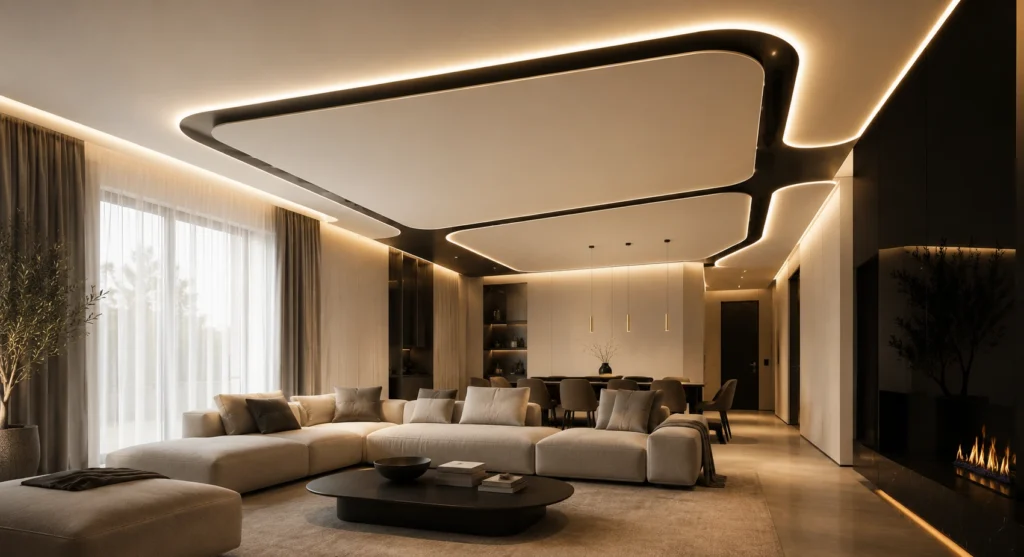
What Is a Stretch Ceiling? A Complete Guide for UK Homeowners
If you are planning a renovation or looking for a modern alternative to a traditional ceiling, you may have come across the term stretch ceiling. Although the technology has been used across Europe for many years, it is still relatively unfamiliar to many UK homeowners.
A stretch ceiling offers a completely different approach to finishing a ceiling. Instead of repairing, plastering and repeatedly painting the existing surface, a new smooth membrane is installed beneath it.
However, appearance is only part of the story. Stretch ceilings can also integrate lighting, conceal imperfections and create architectural features that would be difficult to achieve with a conventional ceiling.
So, what exactly is a stretch ceiling, how does it work, and is it suitable for your home?
What Is a Stretch Ceiling?
A stretch ceiling is a suspended ceiling system that uses a lightweight membrane fitted to a profile around the perimeter of a room.
The membrane creates a smooth and consistent surface below the original ceiling. As a result, cracks, uneven areas, wiring and other elements above the new ceiling can remain hidden from view.
Unlike conventional plasterboard construction, the finished surface does not rely on plastering and painting to achieve its appearance.
Moreover, stretch ceiling systems offer considerable design flexibility. Different finishes, colours, lighting solutions and architectural details can become part of the ceiling design.
This makes the technology suitable for both minimalist interiors and more distinctive architectural projects.
How Does a Stretch Ceiling Work?
The principle behind a stretch ceiling is surprisingly simple.
First, installers attach a specialised profile around the perimeter of the room. The ceiling membrane then fits securely into this profile to create the finished surface.
Because the system sits below the original ceiling, the space between the two surfaces can conceal various technical elements.
For example, the design may accommodate:
- electrical wiring;
- lighting components;
- ventilation elements;
- uneven or damaged ceiling surfaces;
- selected building services.
The exact installation method depends on the chosen system and the requirements of the room.
Once installed correctly, the result is a clean ceiling with a smooth and precise finish.
What Does a Stretch Ceiling Look Like?
One of the main advantages of stretch ceiling technology is its versatility.
A simple design can create a perfectly smooth ceiling that looks understated and contemporary. However, the same technology can produce much more ambitious results.
Different materials and systems allow designers to explore various colours, finishes and forms.
For example, a stretch ceiling can become part of a multilevel ceiling design. Different heights can add depth and visually organise an open interior.
Lighting can also become part of the architecture. Linear Lights Ceilings use integrated LED lines to create distinctive geometric compositions and contemporary illumination.
For something more dramatic, a Starry Sky Ceiling can introduce tiny points of light across the surface and create the impression of a night sky.
Therefore, the technology can adapt to both subtle and highly individual interiors.
What Are the Main Benefits of Stretch Ceilings?
Homeowners often discover stretch ceilings while searching for an alternative to conventional ceiling finishes. However, the system offers several advantages beyond its appearance.
A Smooth, Consistent Finish
Traditional ceilings can develop visible cracks, uneven areas or other imperfections over time.
A stretch ceiling creates a new surface beneath the existing one. Therefore, the original ceiling does not need to look perfect to achieve a clean finished appearance.
Creative Design Freedom
Stretch ceiling technology offers much greater flexibility than a basic flat ceiling.
The design can incorporate different levels, shapes and lighting arrangements. As a result, the ceiling can become an important architectural feature rather than simply the top surface of the room.
Integrated Lighting
Lighting is one of the most interesting possibilities.
LED lines, spotlights and other compatible lighting solutions can become part of the ceiling design. This creates a cleaner appearance because the lighting and ceiling work together.
Moreover, integrated lighting can help define different areas within an open-plan interior.
Low Routine Maintenance
Once installed, a stretch ceiling generally requires relatively little routine maintenance.
The smooth surface is easy to care for. Therefore, homeowners can maintain a clean appearance without regular repainting.
Concealing the Existing Ceiling
Renovating an old ceiling can involve several stages. Cracks may need repair, surfaces may require levelling, and the entire ceiling may need plastering and painting.
A stretch ceiling provides another approach.
Because the new system sits beneath the existing surface, many visual imperfections can remain concealed above it.
Where Can Stretch Ceilings Be Used?
Stretch ceilings can work in many areas of a home.
Living rooms are an obvious choice because the ceiling can become part of the overall interior design. Integrated lighting and multilevel details can create a particularly strong visual effect.
Bedrooms can benefit from softer lighting and clean surfaces. Meanwhile, contemporary kitchens can use stretch ceiling systems to complement minimalist cabinetry and architectural lighting.
Depending on the selected system and project requirements, stretch ceilings may also suit hallways and other residential spaces.
However, the technology is not limited to homes.
Commercial interiors can also benefit from the same flexibility. Offices, hotels, restaurants, showrooms and retail environments can use stretch ceiling systems to combine practical requirements with distinctive design.
Can Stretch Ceilings Improve Acoustics?
Certain stretch ceiling systems can form part of an acoustic solution.
In rooms with many hard surfaces, sound can reflect repeatedly between walls, floors and ceilings. As a result, the space may feel noisy or produce noticeable echo.
Acoustic Ceilings can help manage these reflections when the correct system is used. Similarly, Perforated Ceilings can contribute to acoustic performance while adding visual texture.
However, acoustic treatment and soundproofing are not the same thing.
Acoustic treatment focuses primarily on improving how sound behaves within a room. Soundproofing focuses on limiting sound transmission between different spaces.
Therefore, the correct solution depends on the acoustic problem you want to address.
Can You Customise a Stretch Ceiling?
Yes. In fact, customisation is one of the main reasons homeowners and designers consider stretch ceiling systems.
The possibilities depend on the chosen technology, but a project may include different:
- ceiling levels;
- shapes and architectural details;
- colours and finishes;
- lighting configurations;
- perforation patterns;
- printed designs.
The ceiling can therefore respond to the wider interior rather than being treated as an isolated surface.
This is particularly useful in contemporary architecture, where lighting, furniture and architectural features often follow the same visual language.
How Long Does Stretch Ceiling Installation Take?
There is no single installation time for every project.
A simple ceiling in a straightforward room will naturally require less work than a complex multilevel design with integrated lighting.
Room dimensions, ceiling geometry, lighting and other technical requirements can all affect the installation process.
Therefore, the best approach is to assess the individual space before estimating the project timeline.
One important advantage is that stretch ceiling installation avoids some of the wet finishing processes associated with conventional plastering.
As a result, the installation process can be clean and organised when properly planned.
Are Stretch Ceilings Suitable for Modern UK Homes?
Stretch ceilings are particularly well suited to contemporary interiors.
Many modern UK renovations focus on clean surfaces, architectural lighting and uncluttered spaces. Stretch ceiling technology supports all three.
However, the design does not have to look futuristic.
A simple white ceiling can remain extremely understated. Alternatively, lighting, multiple levels or custom details can turn it into a central architectural feature.
Therefore, the technology works best when the design responds to the property rather than following a fixed style.
Stretch Ceilings vs Traditional Ceilings
A traditional plastered or plasterboard ceiling remains an excellent solution for many properties. Stretch ceilings are not intended to replace every conventional ceiling.
Instead, they provide another option.
A traditional ceiling may make sense when the design is simple and the existing construction is in good condition.
A stretch ceiling becomes particularly interesting when the project requires a very smooth finish, concealed imperfections, integrated lighting or more creative architectural forms.
Therefore, the right choice depends on your interior, budget and design priorities.
We will explore these differences in greater detail in our separate guide to stretch ceilings vs plasterboard ceilings.
Choosing the Right Stretch Ceiling
Before choosing a system, consider what you actually want the ceiling to achieve.
If appearance is the main priority, think about the overall interior style and how prominent you want the ceiling to be.
If lighting matters, plan it at the same time as the ceiling rather than treating it as an afterthought.
For rooms where echo or speech clarity is a concern, an acoustic solution may be more appropriate.
Finally, consider the architecture of the room itself. Ceiling height, dimensions and existing technical elements can influence which solution works best.
A professional assessment can help bring these different requirements together.
Transforming the Ceiling Into Part of the Interior
The ceiling occupies one of the largest uninterrupted surfaces in almost every room. Yet it is often one of the last areas considered during interior design.
Stretch ceiling technology changes that approach.
It can create a simple, refined surface or become a distinctive architectural feature. Moreover, lighting, multiple levels and acoustic solutions can become part of the same overall design.
At SV Ceiling, we create bespoke ceiling solutions around the architecture and purpose of each space.
If you are considering a stretch ceiling for your home or commercial interior, contact our team to discuss your ideas and explore the possibilities.