
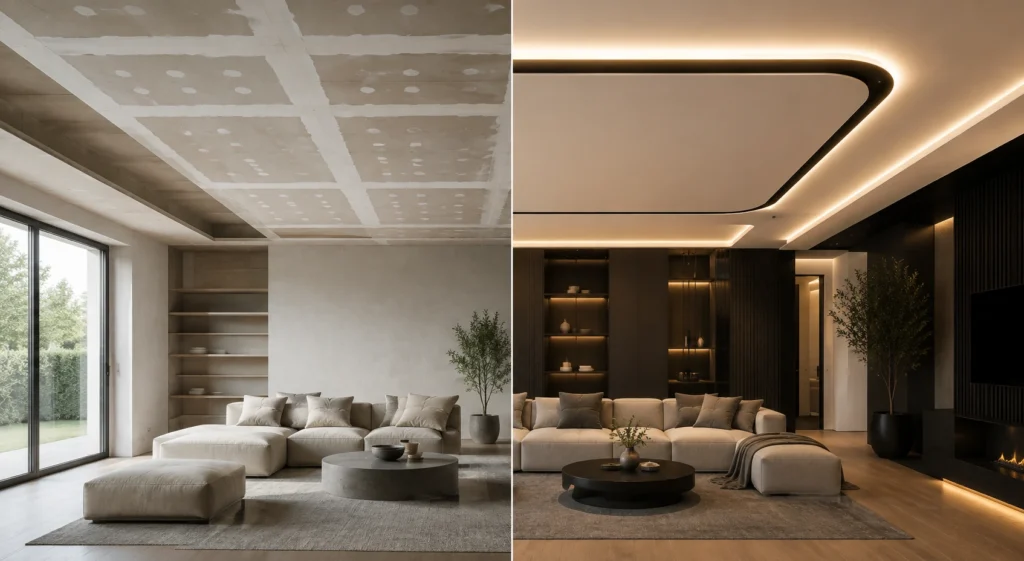
Choosing the right ceiling can have a bigger impact on your interior than you might expect. It affects the appearance of the room, lighting options, installation process and future maintenance.
For many UK homes, plasterboard ceilings are the familiar choice. They are widely used in both new builds and renovations. However, stretch ceilings provide a modern alternative with very different possibilities.
So, when comparing stretch ceilings vs plasterboard, which option is better?
There is no single answer for every property. Instead, the right choice depends on your space, design goals and practical requirements.
In this guide, we explore the key differences to help you decide.
What Is a Stretch Ceiling?
A stretch ceiling is a lightweight suspended ceiling system. A specialised membrane fits into a profile installed around the perimeter of the room.
The new surface sits below the original ceiling. As a result, it can conceal cracks, uneven areas, wiring and selected technical elements.
However, stretch ceilings offer much more than a smooth finish.
They can also become part of the interior design. For example, integrated lighting, multiple levels and distinctive architectural forms can all become part of the ceiling.
Therefore, the system offers considerable freedom for contemporary interiors.
What Is a Plasterboard Ceiling?
Plasterboard is one of the most common materials used for ceilings throughout the UK.
Typically, plasterboard sheets attach to timber joists or a metal framework. The joints then require finishing before the surface receives its final decoration.
Once complete, the result is a solid and familiar ceiling surface.
Plasterboard also offers design flexibility. For example, builders can create bulkheads, recessed sections and other architectural features.
However, more complex designs usually require additional construction and finishing work.
Stretch Ceilings vs Plasterboard: The Main Differences
Both systems can create an attractive ceiling. However, they achieve the finished result in very different ways.
The main differences include installation, appearance, maintenance and design flexibility.
Let’s look at each area in more detail.
1. Installation Process
Installation is one of the clearest differences between the two systems.
Plasterboard ceiling installation usually involves several stages. The exact process depends on the property and chosen finish.
After installing the boards, joints and surfaces need appropriate finishing. Decoration may then follow.
Therefore, a plasterboard project can involve several trades and stages.
A stretch ceiling uses a different approach.
Installers fit a perimeter profile and then install the ceiling membrane. Because the membrane itself creates the finished surface, it does not require conventional plastering and painting afterwards.
As a result, the installation process can involve less wet finishing work.
However, project complexity still matters. A detailed multilevel ceiling with integrated lighting will naturally require more planning than a simple flat ceiling.
2. Finished Appearance
Both options can create an attractive ceiling when professionally installed.
Plasterboard provides the traditional solid appearance found throughout British homes. A well-finished and painted surface can look clean, simple and timeless.
Stretch ceilings can achieve a similarly understated appearance.
However, they also offer other visual possibilities.
Different finishes and architectural configurations allow the ceiling to play a more active role in the design. For example, the surface can work alongside integrated lighting or multiple ceiling levels.
Therefore, stretch ceilings are particularly interesting for homeowners looking for something beyond a conventional flat ceiling.
3. Design Flexibility
This is where the differences become more noticeable.
Plasterboard can create architectural details such as recessed areas and bulkheads. However, complex shapes usually require additional framework, finishing and decoration.
Stretch ceiling technology provides another way to approach these features.
For example, Multilevel Ceilings can introduce different heights and geometric forms. These features can visually organise larger rooms and add architectural depth.
Meanwhile, Linear Lights Ceilings can integrate clean LED lines directly into the overall ceiling composition.
Therefore, lighting and ceiling design can work together rather than being planned as completely separate elements.
For highly individual interiors, this flexibility can become a major advantage.
4. Lighting Options
Lighting has become an increasingly important part of modern interior design.
With a traditional plasterboard ceiling, spotlights, pendant lights, recessed lighting and LED details can all work well. However, the necessary positions and construction details need careful planning.
Stretch ceilings also support a wide range of lighting concepts.
For example, linear lighting can form geometric patterns across the ceiling. Alternatively, concealed lighting can create softer ambient effects.
A Starry Sky Ceiling can take this concept even further. Tiny points of light create a dramatic feature inspired by the night sky.
As a result, homeowners have considerable freedom to combine practical illumination with decorative lighting.
5. Concealing an Existing Ceiling
Older UK properties can sometimes present difficult ceiling surfaces.
Cracks, previous repairs and uneven areas may require significant preparation before decoration.
With plasterboard, one solution is to create a new ceiling beneath the existing surface. However, this still requires boarding and finishing.
A stretch ceiling also creates a new surface below the original ceiling.
Therefore, existing imperfections can remain concealed above the finished membrane.
The space above the new ceiling may also accommodate selected wiring and technical elements. This can help create a cleaner finished interior.
6. Maintenance
Every ceiling needs some level of care over its lifetime.
Painted plasterboard may eventually require redecorating. Small cracks or marks can also appear depending on the building and surrounding conditions.
Stretch ceilings generally require little routine maintenance.
The finished membrane does not need regular repainting. In many situations, gentle cleaning is enough to maintain its appearance.
However, appropriate care always depends on the material and installation.
Therefore, homeowners should follow the maintenance recommendations for their particular ceiling system.
7. Acoustic Options
Acoustics matter in more interiors than people often realise.
Large open-plan rooms can contain many hard surfaces. Consequently, sound may reflect around the space and create unwanted echo.
Standard plasterboard alone does not automatically solve this problem. However, specialist acoustic construction can improve performance.
Stretch ceiling technology can also form part of an acoustic solution.
For example, Acoustic Ceilings can help manage sound reflections within a room. Perforated Ceilings can provide another option where acoustic performance and visual design need to work together.
It is important to remember that acoustic treatment is not the same as soundproofing.
Acoustic treatment manages sound behaviour within the room. In contrast, soundproofing aims to reduce transmission between separate spaces.
8. Repairs and Renovation
The condition of the existing ceiling can influence which system makes more sense.
If a plasterboard ceiling suffers local damage, repair may be relatively straightforward. However, achieving a completely consistent finish can sometimes require additional decoration.
A stretch ceiling avoids decorating the original surface because it creates a separate finished layer beneath it.
This can be useful during renovations where the existing ceiling has many cosmetic imperfections.
However, every property is different.
Before choosing either solution, the condition of the existing ceiling and building structure should be assessed.
9. Ceiling Height
Both systems can reduce the available room height because they may sit below the original structure.
The amount depends on the project.
For a stretch ceiling, the required space can vary according to the system, lighting and technical elements above it.
Similarly, a suspended plasterboard ceiling may require additional depth for its framework and services.
Therefore, ceiling height should be considered during the design stage, particularly in rooms that already have relatively low ceilings.
10. Which Option Offers More Creative Freedom?
For a simple white ceiling, both solutions can work beautifully.
The difference becomes clearer when the ceiling needs to do more.
If you want integrated architectural lighting, multiple levels or unusual visual features, stretch ceiling technology provides considerable flexibility.
For example, the ceiling can become a central design element in a living room or entertainment space.
However, some homeowners simply want a familiar flat surface. In that situation, traditional plasterboard may provide everything the project needs.
The best option is therefore the one that supports the wider interior concept.
Are Stretch Ceilings More Modern Than Plasterboard?
Stretch ceilings are often associated with contemporary interiors because they work particularly well with architectural lighting and minimalist design.
However, that does not mean they only suit ultra-modern properties.
A simple stretch ceiling can look extremely subtle. The design does not need complex shapes or dramatic lighting.
Likewise, plasterboard is not necessarily traditional in appearance. Architects regularly use it in highly contemporary properties.
The material itself does not determine the style.
Instead, the final result depends on how the ceiling relates to the architecture, lighting and rest of the interior.
What About Commercial Interiors?
The same comparison also applies to commercial projects.
Offices, restaurants, hotels, retail environments and showrooms often need ceilings to perform several functions at once.
Lighting, acoustics, visual identity and access to technical services can all influence the design.
Stretch ceiling systems offer considerable flexibility in these situations.
For example, custom lighting can strengthen the character of a hospitality interior. Acoustic solutions can improve comfort in meeting areas. Meanwhile, distinctive ceiling forms can help define zones within larger spaces.
However, plasterboard remains an appropriate solution for many commercial applications.
Again, the project requirements should determine the material.
Stretch Ceiling or Plasterboard: Which Should You Choose?
Choose based on what you need the ceiling to achieve.
A plasterboard ceiling may be suitable if:
- you want a conventional painted ceiling;
- the design is relatively straightforward;
- plasterboard fits naturally with the wider construction project;
- you prefer a traditional solid ceiling system.
A stretch ceiling may be worth considering if:
- you want a smooth and refined finished surface;
- the existing ceiling has visual imperfections;
- integrated lighting is important to the design;
- you want multilevel or architectural ceiling features;
- you are interested in specialist acoustic solutions;
- you want the ceiling to become part of the interior design.
Neither solution is automatically better in every situation.
Instead, the question is which one works better for your particular project.
Frequently Asked Questions
Is a Stretch Ceiling Better Than Plasterboard?
It depends on the project. Stretch ceilings offer significant design flexibility and integrated lighting possibilities. However, plasterboard remains an excellent choice for many conventional ceiling applications.
Can a Stretch Ceiling Replace an Existing Plasterboard Ceiling?
In some projects, a stretch ceiling can create a new finished surface below the existing ceiling. Therefore, removing the existing surface may not always be necessary. The correct approach depends on its condition and the installation requirements.
Can You Install Lights in a Stretch Ceiling?
Yes. Compatible lighting can become part of a stretch ceiling design. Options can include spotlights, linear LEDs and other integrated lighting solutions.
Which Ceiling Is Easier to Maintain?
Stretch ceiling surfaces generally require little routine maintenance and do not need regular repainting. Painted plasterboard may require redecoration over time.
Which Ceiling Is Best for a Modern Interior?
Both can work in modern interiors. However, stretch ceilings provide additional possibilities for integrated lighting, architectural forms and specialist finishes.
Find the Right Ceiling for Your Space
There is no reason to choose a ceiling system based purely on what is most familiar.
Instead, think about the finished interior you want to create.
Plasterboard remains a practical and versatile solution for many UK properties. However, stretch ceilings introduce another level of flexibility. They can combine a refined surface with lighting, architectural details and specialist solutions.
At SV Ceiling, we design each stretch ceiling around the architecture and purpose of the space.
If you are considering a new ceiling for your home or commercial interior, contact our team. We can discuss your project and help you explore the most suitable options.